This week ScienceDaily ran a cluster of three university press releases: why statins can harm muscle, how much helium formed in the first few minutes after the birth of the Universe, and an unusually stout belemnite from Jurassic seas. Checking the original papers shows that all three studies were published before the press releases, the earliest in November 2025. Below, each item explains what was measured, what was found, and where the conclusions stop.
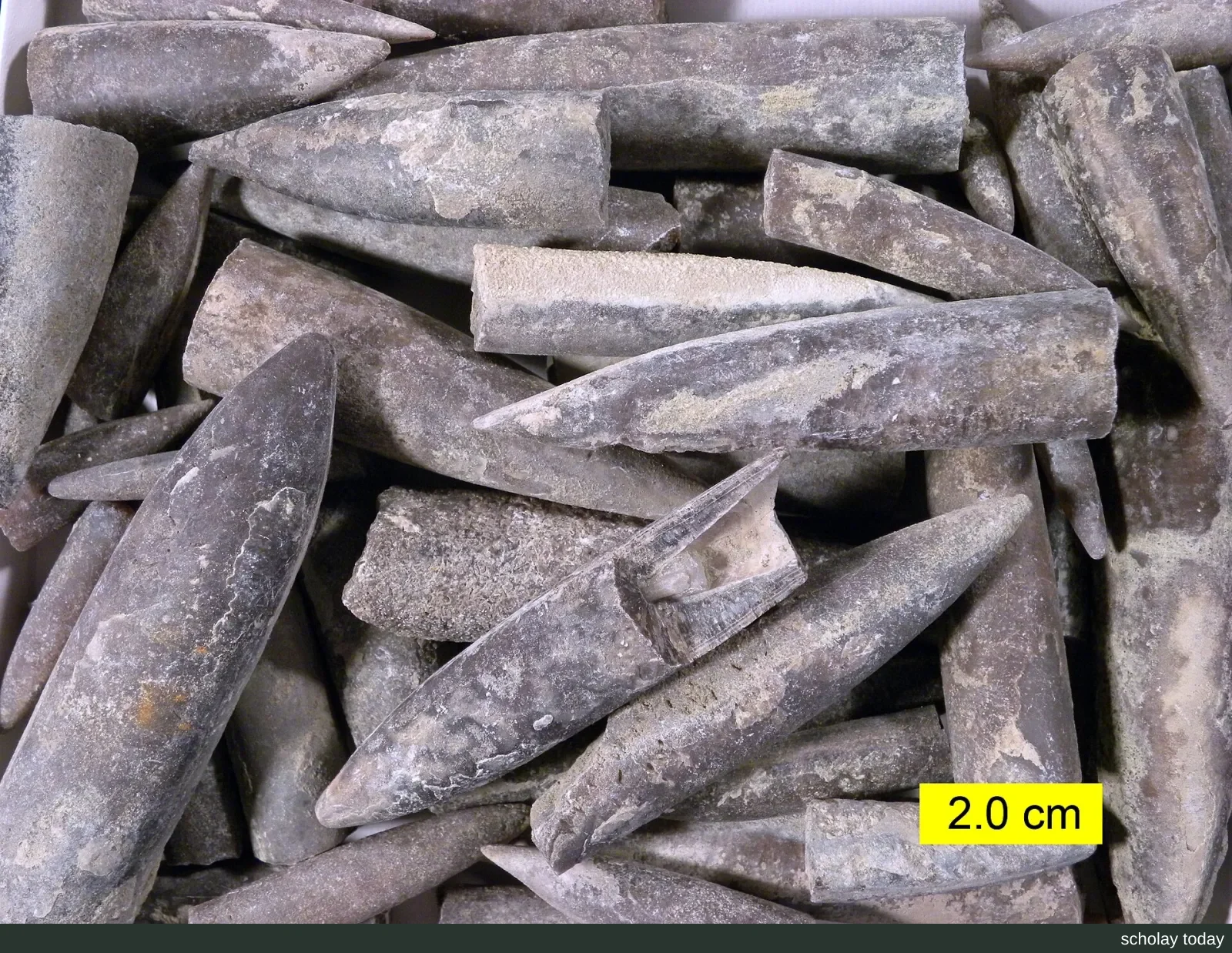
Belemnite fossils commonly found in Jurassic strata in Wyoming, with slender bullet-shaped guards. The guard of Wyoteuthis linsterorum, described in this article, is much thicker, and the image does not show the new species. Image: Wilson44691, Wikimedia Commons, public domain.

How statins open a muscle calcium channel
Statins lower cholesterol by inhibiting HMG-CoA reductase, and more than 2 hundred million people worldwide use them. Their most common adverse effects centre on skeletal muscle. Mild cases involve aches and fatigue, while severe cases involve rhabdomyolysis, which can lead to kidney failure. According to figures cited in the paper, severe muscle symptoms occur in 0.1%–0.5% of users. Observational studies report general muscle pain in as many as 10%–25% of users, though this figure is highly contested. Earlier studies had found that genetic variants in RyR1, the calcium release channel of skeletal muscle, are associated with statin intolerance. However, it had remained unresolved whether statins act on RyR1 directly or influence it indirectly through other proteins or signalling pathways.
A team from the University of British Columbia (UBC) and the University of Wisconsin–Madison used cryo-electron microscopy to solve the structure of rabbit skeletal-muscle RyR1 with and without atorvastatin. The paper was published in Nature Communications on 20 November 2025, and ScienceDaily carried UBC's press release on 20 October 2026. In the control samples, all channels were closed. After atorvastatin was added, about 64% of channel particles adopted an open conformation. The structures show that each RyR1 subunit can bind three atorvastatin molecules, which crowd into a cleft formed by the pseudo-voltage-sensor domain and also interact with one another. Binding happens in sequence. While the channel is closed, each subunit first binds one molecule, causing a slight conformational change that makes the channel easier to open. The other two molecules then enter, prying this domain apart and driving the pore open. In a muscle cell, this would mean a continual leak of calcium ions from the sarcoplasmic reticulum.
The authors also compared this binding mode with the way atorvastatin binds its intended target. In HMG-CoA reductase, the key hydrophilic groups are buried deep in the active site, whereas binding to RyR1 relies mainly on the molecule's hydrophobic portion. On this basis, they propose a direction for designing new statins: modifying the hydrophobic groups to reduce binding to RyR1 while preserving the lipid-lowering effect.
The limits of this study are also clear. It is an in vitro structural experiment that tested only atorvastatin, and to obtain clear structures it used saturating concentrations far above clinical levels. The paper states that the concentration achievable inside muscle cells is currently unknown, and that the plasma concentration at a high dose of 80 mg per day is about 334 nM. Based on half-maximal effective concentrations of 300–400 nM measured in earlier binding experiments, the authors consider the mechanism clinically relevant, but this remains an inference. The hydrophobic portions of simvastatin and pravastatin differ considerably in structure, and it is unclear whether they bind in the same way. Modified statins are for now only a design idea, with no new drug or clinical data. Nor can this study say how much of what people commonly call “statin muscle pain” is actually caused by the drugs.
A new measurement of primordial helium abundance
In the first few minutes after the Big Bang, protons and neutrons fused into helium and other light elements. The primordial helium mass fraction, Yp, depends on the baryon density at that time and on how many kinds of light particles took part in the early Universe's expansion. It can therefore be used to test standard cosmology and the Standard Model of particle physics. The difficulty is that stars have been making helium ever since, so the helium observed today includes later additions. The usual approach is to observe H II regions in a set of galaxies and then use the relation between helium and oxygen abundance to extrapolate by regression to zero metallicity.
The Large Binocular Telescope (LBT) primordial helium project published a series of five papers in volume 1008 of The Astrophysical Journal, which went online on 9 September 2026. The preprints had been submitted to arXiv on 29 January of the same year, and the University of Minnesota's press release appeared on 20 October. The team used the LBT's MODS spectrograph to observe 54 metal-poor H II regions. According to the press release, the team analysed more than ten helium lines and 15 hydrogen lines simultaneously for each target to identify small systematic errors. After screening, 41 reliable targets remained. Of these, 15 extremely low-metallicity targets have high signal-to-noise ratios and oxygen-to-hydrogen ratios no greater than 4×10⁻⁵. They are already close to primordial conditions, so they can be combined directly in a weighted average without relying on extrapolation. The result is Yp = 0.2458 ± 0.0013, an uncertainty of about 0.5%. For comparison, the value the team obtained by regression in 2015 was 0.2449 ± 0.0040, with an error about three times as large. The new value agrees with the standard nucleosynthesis prediction of 0.2467 ± 0.0002, calculated from the baryon density measured by the Planck satellite.
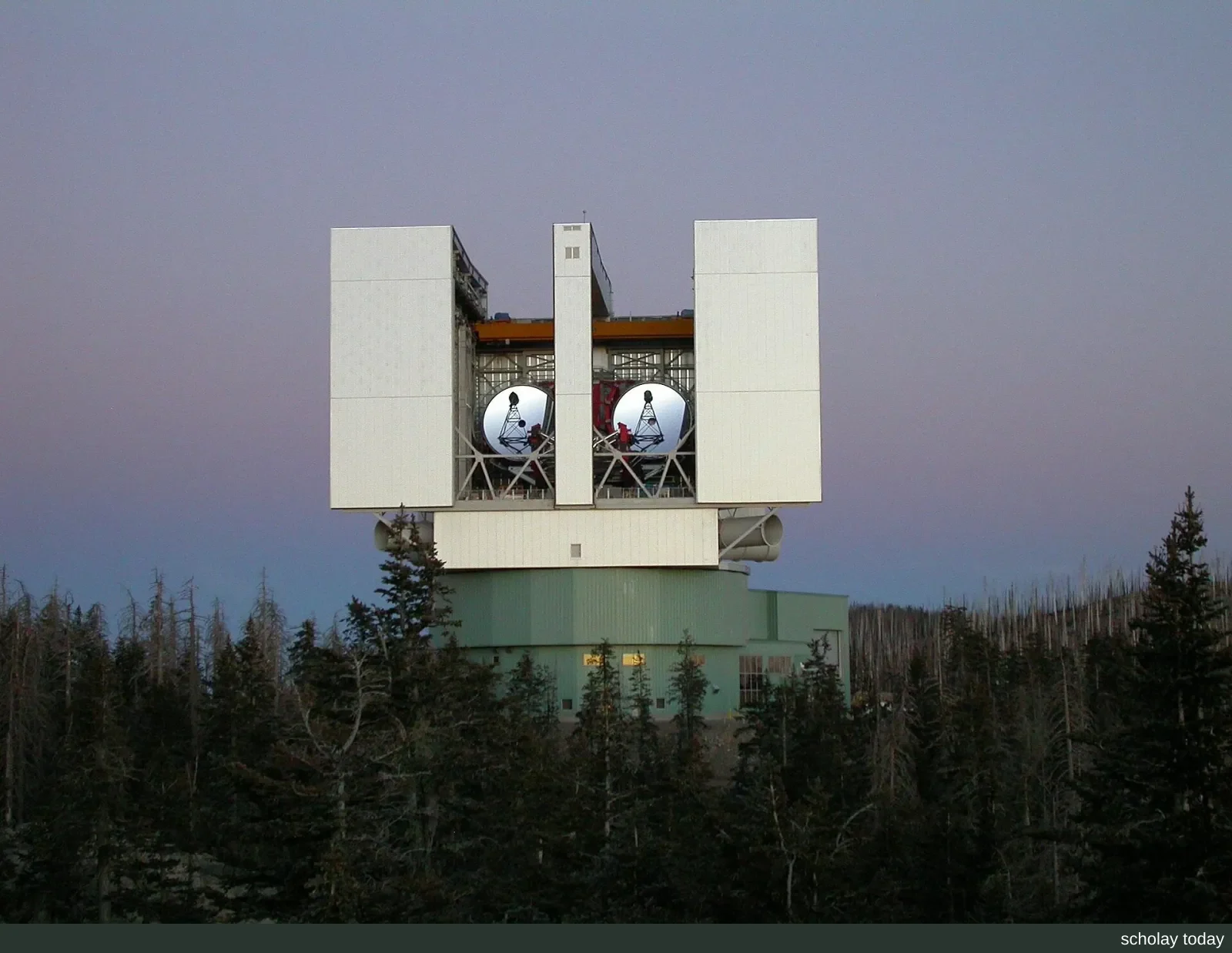
The Large Binocular Telescope (LBT) on Mount Graham, Arizona, USA, with its two 8.4 m primary mirrors mounted side by side. The spectra for the LBT primordial helium project were obtained with its MODS spectrograph. Image: NASA, Wikimedia Commons, public domain.

The fifth paper combines the new helium value with deuterium abundance and cosmic microwave background data. If the number of neutrino species is allowed to vary freely, the result is Nν = 2.925 ± 0.082, consistent with the three neutrino species of the Standard Model. If the number of species is assumed to be no fewer than three, the upper limit on additional species is 0.125 (95% confidence level).
The “15 primordial galaxies” mentioned in the press release refers to the number of targets in the final average. The full observed sample has 54. The “threefold improvement in precision” is relative to the team's own previous result. The paper also acknowledges that residual systematic errors remain from the contribution of stellar nucleosynthesis to helium. These results tighten constraints on the early Universe and confirm that it is compatible with existing theory. They do not amount to the discovery of new particles beyond the Standard Model.
Wyoming's chunky Jurassic belemnite
Belemnites are extinct cephalopods related to today's squid and octopuses. The part most often found as a fossil is the bullet-shaped internal skeleton, known as the “guard”. The Sundance Formation in Wyoming preserves deposits from a Late Jurassic inland sea, and these fossils are so abundant there that they accumulate in layers. On 9 September 2026, researchers from the United States, the United Kingdom and New Zealand described two unusual belemnite guards in Papers in Palaeontology. The guards come from the upper Redwater Shale Member of the formation and are Oxfordian in age (about 1.6 hundred million years ago). The researchers named them as a new genus and species, Wyoteuthis linsterorum. The University of Manchester's press release appeared on 20 October.
The guards of the two specimens are about 60 mm in diameter at the anterior end, making them the thickest belemnite guards known. According to the press release, the belemnites common in the same strata are generally 5–10 cm long and only 1–2 cm wide. The researchers combined CT scans with morphological details, including the shape of the guard, the position and angle of the internal cavity and the grooves at the tip, to assign it to the family Megateuthididae. This family flourished from the late Early Jurassic to the Middle Jurassic, and most of its members had disappeared by the Bathonian, with only sporadic records afterwards. The authors therefore regard Wyoteuthis as a relict lineage of the family, possibly derived from Brevibelus of the North American Bajocian. On this basis, they propose that the northeastern Pacific once held a previously unrecognized refugium. The paper also notes that similar-looking specimens from the same basin reported in the literature actually belong to another family.
Burkhard Pohl collected the first specimen in the late 1990s, and it then sat in a collection drawer for many years. Cliff Linster found the second specimen and donated it to the Wyoming Dinosaur Center in 2019, and it has now been designated the holotype. The evidence therefore consists of just two specimens, and the anterior ends of both are crushed or missing. The press release gives the guard length as about 10 cm. The paper describes a preserved length of more than 130 mm and an estimated complete length of about 160–175 mm, and this article follows the paper. Using the reconstruction proportions of Klug et al. from 2024, the authors roughly estimate a total length including the arms of about 55–60 cm and a mantle length of 30–35 cm. They also note that the reference samples include no guards of this short, stout type and lack key parameters, so the estimate is only approximate. To explain why the animal is so rare, the paper lists several possibilities, such as highly specialized prey or habitat, or living mainly on the outer shelf. The press release's claim that it “preyed on smaller belemnites living alongside it” is likewise the authors' speculation.
References
-
Molinarolo S, Valdivia CR, Valdivia HH, Van Petegem F. Cryo-electron microscopy reveals sequential binding and activation of Ryanodine Receptors by statin triplets. Nature Communications, 2025, 16: 11508. doi:10.1038/s41467-025-66522-0
-
University of British Columbia. Scientists finally uncover why statins can cause muscle pain. ScienceDaily, 2026-10-20. https://www.sciencedaily.com/releases/2026/10/261019093447.htm
-
Skillman ED, Pogge RW, Aver E, et al. The LBT Yp Project. I. An Improved Determination of the Primordial Helium Abundance—Project Description, Sample Selection, Observations, and Methodology. The Astrophysical Journal, 2026, 1008(2): 237. doi:10.3847/1538-4357/ae879f
-
Aver E, Skillman ED, Pogge RW, et al. The LBT Yp Project. IV. A New Value of the Primordial Helium Abundance. The Astrophysical Journal, 2026, 1008(2): 240. doi:10.3847/1538-4357/ae879b
-
Yeh T-H, et al. The LBT Yp Project. V. Cosmological Implications of a New Determination of Primordial 4He. The Astrophysical Journal, 2026, 1008(2): 241. doi:10.3847/1538-4357/ae879c
-
University of Minnesota. Astronomers uncover new secrets of the Universe’s first five minutes. ScienceDaily, 2026-10-20. https://www.sciencedaily.com/releases/2026/10/261019093442.htm
-
Ippolitov AP, Lippincott JL, Wahl WR, Lomax DR. ‘The big chunky belemnite’: a new relict megateuthidid from the Oxfordian (Late Jurassic) of Wyoming, USA, and its place in the evolutionary history of the group. Papers in Palaeontology, 2026, 12(5). doi:10.1002/spp2.70123
-
University of Manchester. Scientists discover a bizarre Jurassic “squid” unlike anything ever seen. ScienceDaily, 2026-10-20. https://www.sciencedaily.com/releases/2026/10/261019093434.htm
-
The LBT Yp Project. IV. A New Value of the Primordial Helium Abundance
-
The LBT Yp Project. V. Cosmological Implications of a New Determination of Primordial 4He
-
Compiled and published by Scholay, the one-stop academic platform. If any content infringes your rights, please let us know and we will take it down.
-
Also published on EnterScholar, a community for scholars in the age of intelligence.