The first round of collaborative industrial research calls under the UK's National Materials Innovation Programme by Innovate UK will close at 11:00 a.m. UK time on October 28, 2026, equivalent to 7:00 p.m. Beijing time. The maximum funding pool for this round is £12 million, with individual project applications ranging from £500,000 to £1 million in funding. The projects must be led by a UK-based company and involve at least one UK-based SME applying for funding and one named end-user downstream customer.

Enterprises and researchers conduct collaborative R&D on advanced materials samples. AI-generated schematic.
Contributor and funding amount
The funding partners seeking proposals this time are Innovate UK, a body under the UK Research and Innovation (UKRI). The official name of the application page is 'National Materials Innovation Programme: CR&D Rd1'. It belongs to the National Materials Innovation Programme (NMIP), announced under the Advanced Manufacturing sector of the UK's Modern Industrial Strategy. According to a news release issued by the Henry Royce Institute on September 1, 2026, the programme has a total scale of approximately 80,000,000 pounds sterling, with an implementation period from 2026 to March 2030. This round is the first collaborative industrial research funding call under the programme. The IFS background statement reads: This is the third competition under the programme and the first funding call for collaborative research launched after the programme's official commencement.
12 million pounds is the upper limit of the funding pool for this round. IFS explicitly states that the actual amount committed depends on whether sufficient high-quality applications are received. Per project, the total amount of eligible funding applications must fall between 500,000 and 1,000,000 pounds. The UKRI Funding finder page lists 12 million pounds in the 'Minimum award' field, which may be misinterpreted as the minimum per project; however, the per-project funding amount should be determined according to IFS's project scale criteria. Additionally, pursuant to the subsidy rules applicable to this competition, no single enterprise may receive funding exceeding 3 million pounds in the same competition.
This competition only funds industrial research projects, with funding proportions differentiated by organization size. Organizations engaged in commercial or economic activities, including micro and small enterprises, may receive up to 70% of eligible costs; medium-sized enterprises up to 60%; and large enterprises up to 50%. Academic institutions, research and technology organizations (RTOs), and other research bodies engaged in non-economic activities may collectively receive up to 30% of the total eligible costs of a project; academic institutions may claim up to 80% of full economic costs (FEC), while RTOs, charitable, non-profit, and public sector research organizations may receive up to 100%. An example provided on the Innovate UK Business Connect page is: a consortium of several small enterprises applying for £700,000 in funding, at 70%, resulting in a total project cost of approximately £1,000,000, with the remaining £300,000 to be self-funded by the members.
The project duration will be between 18 and 30 months, with commencement no later than February 1, 2027, and completion no later than July 31, 2029; the start date must fall on the first day of a month. According to the IFS timeline, applicants are expected to receive results around December 2, 2026. The funded party must conduct project work in the UK, utilize the outcomes in the UK, and spend the majority of the funding within the UK. IFS also notes that, based on historical experience from similar competitions, the success rate is approximately 20%, which is solely for historical reference and does not indicate the admission rate for this round.
Team qualification criteria and partners
This round only accepts cooperation applications, and a single enterprise cannot apply independently. A qualified consortium must simultaneously meet the following conditions:
- The lead party must be a company registered in the UK, with no size limitations;
- The consortium must include at least one micro, small, or medium-sized enterprise registered in the United Kingdom, and this enterprise must have applied for funding in this application;
- The lead organization and at least one other organization shall apply for funding;
- The cost claimed by any single organization shall not exceed 70% of the total project cost;
- At least one named downstream end-user is present and assumes a clearly defined role in the project governance or work plan.
End-user refers to organizations located downstream in the supply chain that will use this material innovation or directly benefit from it, such as original equipment manufacturers (OEMs) and first-tier suppliers, and must operate within one of the eight growth-driven industries identified in the UK industrial strategy (IS-8). An end-user may join the project advisory committee or participate as a funding applicant or non-applicant partner. RTOs, academic staff and academic institutions, consultants and consulting firms are not eligible to act as end-users; government bodies or regulatory authorities may be considered if they provide sufficient justification, for example, if they are system integrators or service providers for this material innovation. IFS specifically notes that written documentation such as support letters, correspondence, memoranda of understanding, letters of intent, or supply contracts alone is insufficient to demonstrate that an end-user has participated in the project.
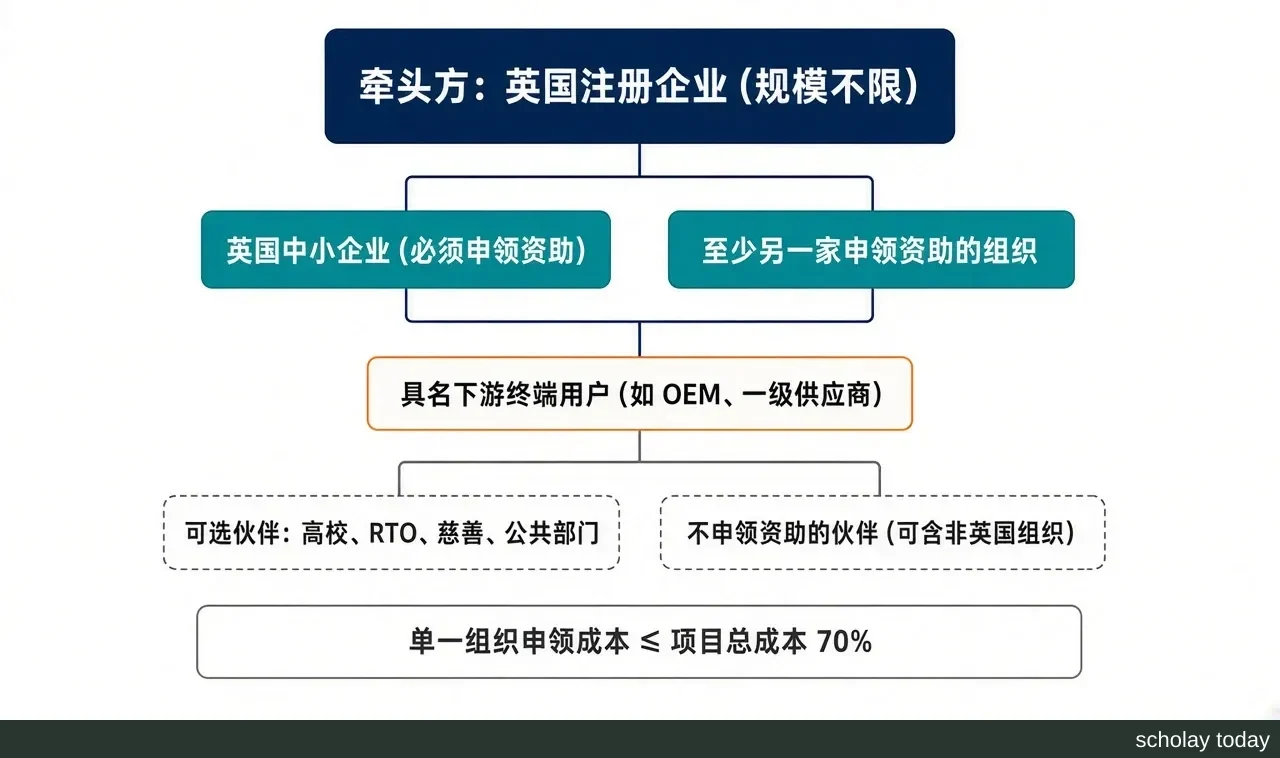
The schematic illustrating the tiered criteria for team formation of this round is based on the IFS competition briefing.
Partners that may be included are UK-registered companies, academic institutions, charities, non-profit organisations, public sector organisations and RTOs. Projects may also have partners who do not claim funding and bear their own costs, which may include EU and other non-UK organisations; non-UK partners may carry out project activities within their own country and may use the outcomes outside the UK, with their costs included in the total eligible cost. The total subcontracting amount shall not exceed 30% of the total eligible cost. When selecting overseas subcontractors, justification must be provided for why UK subcontractors could not be used; lower prices are not a valid reason. The number of applications is also subject to limits: a company may lead only one application and may participate as a partner in up to two; companies that are not leading and academic institutions, RTOs and similar organisations may participate in an unlimited number of applications.
Funding theme and exclusion scope
The application must align with one of four themes and must fall within at least one sub-theme. The first three are high-growth opportunity themes identified by the National Materials Innovation Strategy, and the fourth is a separately added strategic opportunity theme.
- Future medical solutions(Future Healthcare Solutions): Biomaterials with biocompatibility and regenerative properties; bioelectronic materials.
- Innovation in structural materials(Structural Materials Innovation): Sustainability; surface engineering; design and deployment; extreme environments. Limited to the material categories listed in the briefing, including specialty steels, advanced non-ferrous metals and high-performance alloys, fiber-reinforced structural composites, structural and wear-resistant technical ceramics, advanced structural glasses and microcrystalline glasses, advanced concrete and geopolymer materials, and high-performance engineering polymers for load-bearing applications.
- Power Electronics and Interconnections(Power Electronics and Connectivity): Wide-bandgap and ultra-wide bandgap materials; advanced interconnect materials.
- Metamaterials and metasurfaces(Metamaterials and Metasurfaces): Future telecommunications and advanced interconnects; convergent electronic-photonic technologies; thermal, acoustic, and mechanical metamaterials; energy security and net zero; healthcare.
The topic of metamaterials overlaps with the first three topics, and IFS has specified that if the innovation is fundamentally based on metamaterials or metasurface technologies, it must be reported under Topic 4. The application form must also explain how the material innovation enhances performance, functionality, productivity, or sustainability, identify the target IS-8 industry and specific applications, provide a pathway for scaling up and commercialization in the UK, and describe the contribution of adopting this material innovation to the UK's net zero goals.
The circumstances under which funding is not granted are also specified. Projects that use digital tools such as artificial intelligence or machine learning to support materials research, but whose focus is not on materials innovation itself, are not covered; projects that do not name and describe the end-user role or that do not specify the IS-8 industry and its applications are not funded; projects focused on chemical or raw material synthesis, rather than on the application of materials in end-user settings, are not funded; projects solely targeting defense are not funded, dual-use projects are acceptable provided the primary focus is civilian; projects focused on regulatory frameworks, educational resources, behavioral sciences, policy, skills, and other supporting fields are likewise not eligible for funding.
Deadline and application channels
The deadline is subject to IFS: 11:00 am on October 28, 2026 (British time). The UK ended daylight saving time on October 25, after which British time is 8 hours behind China Standard Time, so 11:00 British time corresponds to 19:00 China Standard Time on October 28. The Royce Institute News and Business Connect opportunities page also lists 11:00; the UKRI Funding Finder entry as of the time of this article shows 16:00 on the same day. IFS explicitly states that the competition will be based on the deadline stated in its briefing, and does not guarantee that information on other government or third-party websites is always accurate. Applications that have been submitted can be reopened and modified before the deadline, but must be resubmitted before the deadline.
Apply uniformly through the Innovation Funding Service: the lead organization will invite partners via the system, and each partner will fill in their own costs and project impact issues. To find partners, contact Innovate UK Business Connect, which provides an enterprise matching platform for this competition. The recording and slides from the briefing session on September 3 are available on the IFS page. The two Q&A sessions on September 11 and October 7 have already concluded. For application inquiries, email support@iuk.ukri.org or call 0300 321 4357, with call reception hours from 9:00 to 12:00 and from 14:00 to 17:00 British time on business days.
The information in this article is compiled based on the official pages mentioned above, verified at 24 October 2026, Beijing Time. Only a few days remain before the deadline, and teams that have not yet formed must first confirm whether they can assemble a leading enterprise, a small and medium-sized enterprise applying for funding, and named end-users within the time limit.
References
-
Innovate UK. Funding competition National Materials Innovation Programme: CR&D Rd1 – Competition overview Innovation Funding Service. Accessed on 2026-10-24.
-
UKRI. Funding opportunity: National Materials Innovation Programme: CR&D Rd1 Published on 2026-09-03, accessed on 2026-10-24.
-
Henry Royce Institute. National Materials Innovation Programme Launches Collaborative R&D Competition. September 1, 2026, accessed on October 24, 2026.
-
Innovate UK Business Connect. National Materials Innovation Programme: CR&D Rd1 Accessed on 2026-10-24.
-
Information provided by Scholay Academic One-Stop Platform Organize and publish; if there is any infringement, please provide feedback for removal.
-
Information synchronization published in EnterScholar, Scholar Community in the Intelligent Age