The papers behind the three studies in this issue were published between June and September 2026, and ScienceDaily republished coverage of all three on October 22. A two-year trial at the University of Southern California got DHA into cerebrospinal fluid but did not improve cognition; the German Primate Center used brain organoids to explain why the marmoset brain is nearly smooth; and the University of Oxford weighed virus-like particles one at a time to record their assembly steps. Each of the three conclusions has clearly defined limits.

Common marmoset (Callithrix jacchus), photographed in Sugarloaf Mountain Park, Rio de Janeiro, Brazil. Unlike most primates, it has a small, nearly smooth cerebral cortex. Photo: Wilfredor. Source: Wikimedia Commons. License: CC0 1.0.
High-Dose DHA Reaches Cerebrospinal Fluid but Does Not Improve Cognition
The trial, called PreventE4 (registration number NCT03613844), was carried out by Hussein N. Yassine's team at the Keck School of Medicine of the University of Southern California. The paper was published online in eBioMedicine on June 18, 2026. The University of Southern California issued a press release the same day, and ScienceDaily republished it on October 22. The trial was a single-center, phase IIa, randomized, double-blind, placebo-controlled study conducted from September 2018 to May 2024. The 365 participants were aged 55 to 80 and did not have dementia. They normally consumed less than 200 milligrams of DHA a day and had at least one risk factor for dementia. Of these, 173 (47%) carried APOE ε4, the strongest known genetic risk factor for late-onset Alzheimer's disease. Participants were first split into two groups according to whether they were willing to undergo a lumbar puncture. Within each group, they were then randomized 1:1 to take 2 grams of DHA or a placebo every day for 24 months.

An example photo of omega-3 fish oil softgels. This is not the product used in the PreventE4 trial. Photo: Oddman47. Source: Wikimedia Commons. License: CC0 1.0.
The trial's primary outcome was the change in the ratio of DHA to arachidonic acid (AA) in cerebrospinal fluid at 6 months. The ratio rose by 0.17 in the DHA group and fell by 0.02 in the placebo group, a between-group difference of 0.19 (95% confidence interval 0.16–0.21), regardless of APOE ε4 carrier status. The paper also reports that supplementation raised cerebrospinal fluid DHA by an average of 17% and raised the red blood cell omega-3 index from 4.9% to 11.0%. This indicates that the supplemental DHA did reach the central nervous system. At 24 months, however, the two groups did not differ in hippocampal volume, cortical thickness or cognitive test scores. Adverse events were comparable between the two groups, and no serious adverse event was judged to be related to DHA.
Several points matter when interpreting this result. Hippocampal volume and cortical thickness were secondary outcomes, and the cognitive tests were exploratory outcomes. The paper reports only estimates and confidence intervals, not P values. The dropout rate at 24 months was 38%, mainly because of the COVID-19 pandemic. Those who withdrew were more often Hispanic and had lower educational attainment, baseline cognitive scores and plasma DHA. The authors believe this may have biased the results and weakened the trial's ability to test clinical outcomes. Participants were 66 years old on average and highly educated. Hippocampal atrophy in both groups was less than 0.5% per year, and cognitive scores rose in both groups, so a difference from the intervention would have been hard to detect within two years in any case. What the trial can show is this: among these cognitively normal people who ate little fish, two years of high-dose DHA supplements produced no measurable benefit for cognition or brain structure. The trial did not test the effects of eating fish or following a Mediterranean diet, and its results cannot be directly extended to people who already have cognitive impairment. The authors suggest that future research should focus on how the brain metabolizes DHA rather than on more supplement trials of the same kind.
Marmoset Neural Progenitor Cells and Cortical Downscaling
This study was carried out by the junior research group led by Michael Heide at the German Primate Center (DPZ, Leibniz Institute for Primate Research). The paper was published online in volume 12, issue 39 of Science Advances on September 23, 2026. The DPZ issued a German-language press release the same day, and ScienceDaily republished the English version on October 22. Most primates have a large, highly folded cerebral cortex, but the common marmoset (Callithrix jacchus), a small South American monkey, has a small, nearly smooth one. Comparative studies suggest that the common ancestor of primates already had a medium-sized, folded cortex, so the marmoset's smooth cortex is regarded as the result of evolutionary downscaling. Early in fetal development, the marmoset brain has cell types and layers similar to those of primates with highly folded brains. The study set out to explain why the marmoset later produces fewer neurons.
The researchers grew cerebral organoids from three induced pluripotent stem cell lines each from humans and marmosets. Some experiments also included rhesus macaque organoids as a comparison, and the results were checked against marmoset fetal brain tissue and previously published tissue images. The researchers found several concurrent differences in the neural progenitor cells that produce neurons. First, marmoset apical radial glial cells divide more slowly. At day 30 of culture, their cell cycle lasted about 68.5 hours, compared with about 57.2 hours in humans. In addition, a substantial proportion of marmoset progenitor cells did not enter the DNA replication phase during the 84-hour labeling period and may have paused division. Second, progenitor cells shift from being concentrated in the ventricular zone to being found mostly in the subventricular zone later and more abruptly. This leaves a shorter window for further expansion and neuron production. Third, basal radial glial cells are considered the main drivers of cortical expansion. In marmosets, these cells show lower expression of the PALMD gene, and most extend only a single basal process. This makes them morphologically simpler than the same cells in humans, rhesus macaques and ferrets, and the morphological complexity of these cells is associated with their ability to proliferate. The researchers also found that the transcriptional profiles of marmoset organoids cultured for 50 days most closely matched marmoset fetal brains at gestational day 90. This match provides a timing reference for comparing organoids with actual development.
The authors note in the paper that the differences between human and marmoset organoids may stem partly from how well the culture conditions suit each species or from differences in developmental speed. It therefore cannot be fully ruled out that some differences reflect how mature the organoids are rather than each species' intrinsic developmental program. The developmental trajectories of cell lineages were inferred from single-cell data, and the analysis of basal progenitor cell shapes reanalyzed images of 4 previously published marmoset fetal brain sections. The study focused on one factor, reduced neuron output. Other factors that might affect folding, such as the extracellular matrix and tissue mechanics, have not yet been tested. ScienceDaily's English headline says the study found a “secret behind the human brain's wrinkles,” but the paper examines why the marmoset cortex became smaller and flatter. As for helping us understand disorders of human brain development, the DPZ press release says only that this may be possible in the future.
Weighing Virus-Like Particles One by One to Record Their Assembly
This paper is by Roi Asor, Dan Loewenthal, Philipp Kukura and colleagues at the Department of Chemistry and the Kavli Institute for Nanoscience Discovery at the University of Oxford. It was published online in Nature on September 16, 2026, and is open access. The University of Oxford issued a press release the same day, and ScienceDaily republished it on October 22. A virus's protein shell, or capsid, assembles itself from dozens to thousands of protein subunits without guidance from external machinery. The intermediate structures that form during assembly are brief and rare. Traditional methods can mostly capture only the starting materials and the finished particles, so the intermediate steps have mainly been inferred from theoretical models.
The team did not study a natural virus but an engineered virus-like particle called mi3-VLP. In this particle, 60 identical protein monomers first form 20 trimers, which then assemble into a dodecahedron with 12 pentagonal faces. Particles of this kind are also being evaluated as a platform for multivalent vaccines. The researchers used mass photometry, a method that measures the mass of an individual molecule from the light it scatters. They first anchored tagged trimers on an artificial lipid membrane to form pentagonal rings as starting points. They then used circular lipid-membrane “traps” 5 micrometres in diameter to keep single growing particles in view and “weigh” them continuously. The results show that a single binding event between trimers has a dissociation constant of about 2 micromolar. This is a weak interaction, so mismatched combinations quickly separate and try again. Once several subunits close a face, the multiple contacts stabilize the structure. The first stable intermediate is a pentagonal ring of five trimers. Forming it requires several weak bonds to hold at the same time, which makes it the slowest step in the whole process. After that, closing the next face requires only three more trimers and then two more to bind in sequence, so growth speeds up. In 25 single-particle assembly trajectories, the researchers did not see any closed structure fall apart again. These results explain why this kind of assembly is slow to start but fast afterward. They also explain why it reliably reaches the same final structure despite thousands of possible intermediate states.
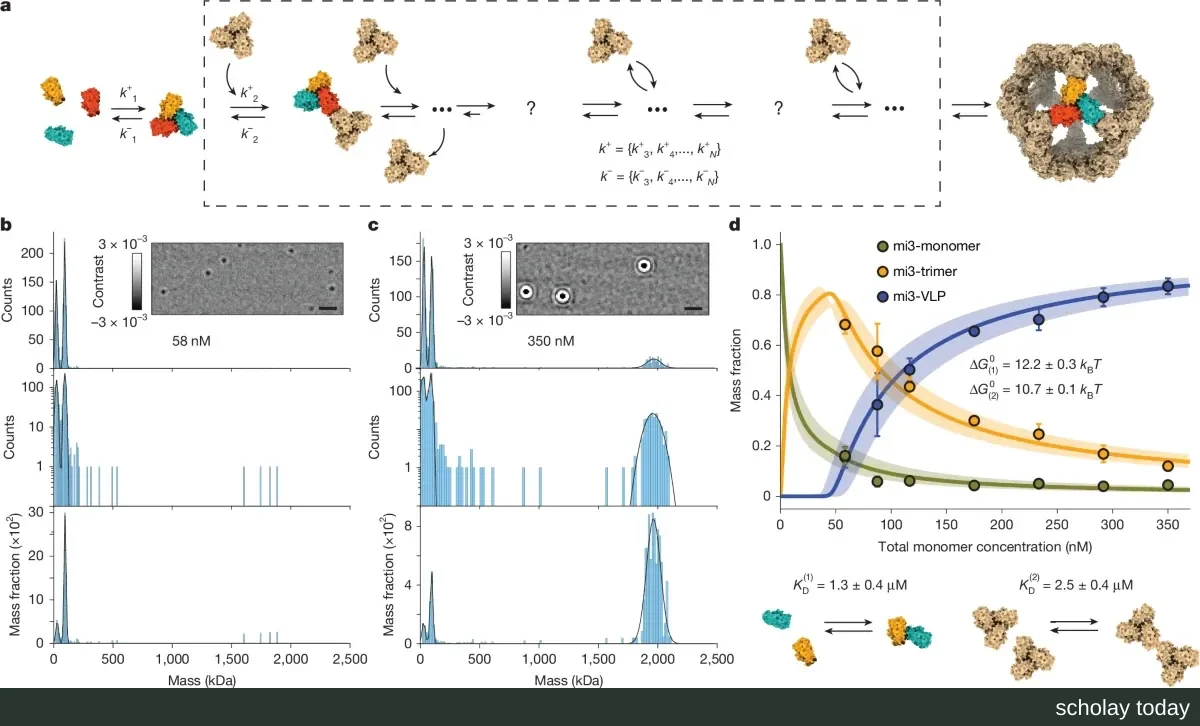
Figure 1 of the paper: a schematic of how the engineered mi3 virus-like particle (not a natural virus) assembles in stages from monomers to trimers to a dodecahedral particle, along with the mass distribution of each component measured by mass photometry. The image has not been cropped. Source: Asor R. et al., Nature, 2026. License: CC BY 4.0.
The study's scope is also clearly limited. mi3-VLP is a dodecahedron, whereas most viral capsids are icosahedral. The authors expect the basic physical principles to be the same, but the specific intermediate structures and assembly pathways will vary with the geometry of the capsid. The experiments used empty shells without a genome. The single-particle experiments started from a pentagonal ring that had already been formed on the lipid membrane, and assembly took place close to equilibrium with a small driving force. Factors such as conformational regulation and shell elasticity still need to be studied. The press release mentions antiviral drugs and vaccine design as possible applications, but the paper itself did not test any drug or vaccine.
How Far the Evidence Goes in the Three Studies
Each of the three studies first obtained solid measurements at an intermediate level and then extended its conclusions to larger questions. The fish oil trial confirmed that DHA reached the cerebrospinal fluid but found no difference in cognition or brain structure. This shows that a drug reaching its target is not the same as a drug producing clinical benefit. The marmoset study found cellular differences in organoids that reduce neuron output and calibrated the timing against fetal brain tissue, but organoids are still not fully developed brains. The Oxford team clearly observed the assembly pathway of an engineered particle, but whether natural viruses assemble in the same way still needs to be tested on real capsids. When reading reports like these, first check what level the study actually measured: molecules, cell models or outcomes in people. Then consider how many steps separate the headline's conclusion from that level.
References
-
Yassine HN, Pour SG, Juarez M, et al. CNS target engagement of high-dose DHA supplementation in older adults at risk for dementia: a randomised, double-blind, placebo-controlled trial. eBioMedicine, 2026, 129: 106316. Published online 2026-06-18. doi:10.1016/j.ebiom.2026.106316
-
Keck Medicine of USC. Fish oil supplements may not prevent Alzheimer’s-related decline. 2026-06-18. Link
-
University of Southern California - Health Sciences. Millions take fish oil for brain health. A two-year study found no benefit. ScienceDaily, 2026-10-22. Link
-
Tynianskaia L, Bastidas-Betancourt CM, Grewe EM, et al. Coordinated neural progenitor adaptations contribute to primate neocortical downscaling. Science Advances, 2026, 12(39): eaeg5563. Published online 2026-09-23. doi:10.1126/sciadv.aeg5563
-
Deutsches Primatenzentrum. Glatt statt gefaltet – Hirnentwicklung bei Primaten. idw, 2026-09-23. Link
-
Deutsches Primatenzentrum (DPZ)/German Primate Center. Scientists discover a surprising secret behind the human brain’s wrinkles. ScienceDaily, 2026-10-22. Link
-
Asor R, Loewenthal D, Melnyk D, Tan TK, Kukura P. Molecular-level observation of the self-assembly of a virus-like particle. Nature, 2026, 657(8132): 653. Published online 2026-09-16. doi:10.1038/s41586-026-10948-z
-
University of Oxford. New method reveals how virus particles can build themselves, molecule by molecule. 2026-09-16. Link
-
University of Oxford. Oxford scientists discover how viruses build themselves without a blueprint. ScienceDaily, 2026-10-22. Link
-
This information was compiled and published by Scholay, the all-in-one academic platform. If you believe it infringes your rights, please let us know and we will take it down.
-
This information is also published on EnterScholar, a community for scholars in the age of AI.