The European 'Resilient Cultural Heritage' Partnership Programme (RCH) has announced the first round of cross-border joint calls, with 28 funding institutions planning to commit over 27 million euros to support interdisciplinary research on climate change and cultural heritage. Applications must be submitted by partnership teams comprising at least three participating countries, with the pre-application deadline provisionally set for January 11, 2027. This article is based on information compiled from official websites regarding the initiating bodies, teaming requirements, timeline, and application channels, verified on October 23, 2026.
Initiator and funding theme
RCH stands for European Partnership for Resilient Cultural Heritage, a European partnership program jointly funded by the European Union's Horizon Europe program. According to the Austrian ERA portal on October 20, 2026, the program was officially launched on September 29, 2026, in Marseille, France, with a duration of ten years, involving more than 90 partners from 30 countries; the program's preview page states that there are 34 funding institutions involved. The first round of joint calls involved 28 funding institutions covering 25 countries, with a projected public funding amount of 'over 27 million euros,' which is an indicative figure; funded projects are expected to start as early as December 2027.
The English title of the call is "Foundations for climate-resilient cultural heritage: Assessing and managing impact and risk, dealing with damage and loss", meaning establishing foundations for climate resilience of cultural heritage: assessing and managing impacts and risks, addressing damage and losses. The announcement explicitly states that the thematic scope is intentionally broadened, listing four sub-themes:
- Risk and impact assessment, as well as risk preparedness and management of cultural heritage;
- Manage the cultural heritage losses and damages caused by natural disasters induced by climate change;
- Treat traditional, local, and indigenous knowledge systems and practices as resources and frameworks for social resilience in the context of climate change;
- Sustainable governance of the cultural heritage sector.
The call page of the French National Research Agency (ANR) states that this round of funding aims to combine humanities and social sciences, engineering sciences, and climate sciences to produce knowledge and resources usable by policymakers in formulating heritage and climate policies. The objectives listed on the partners' program homepage also include promoting applied interdisciplinary collaborations between humanities and social sciences and science and engineering disciplines, as well as between heritage research communities and climate research groups. From these statements, the call envisages interdisciplinary teams rather than separate disciplinary groups working independently; directions such as heritage conservation, archaeology, architecture, climate modeling, disaster management, and heritage governance are all related to the sub-themes, but funding eligibility still depends on the specific proposals and national regulations.
Team selection criteria and funding rules
The currently available team selection rules are most detailed in the "General Application Criteria" section of the ANR call page, where ANR also serves as the secretariat for the joint call.
- The project duration is 24 to 36 months, funding is only provided for transnational projects.
- The applicant entity is determined according to the rules of each country or region, and categories include non-profit organizations undertaking public research missions (research institutes, universities, scientific cooperation foundations), other non-profit entities (public institutions, non-governmental organizations, etc.), and private enterprises.
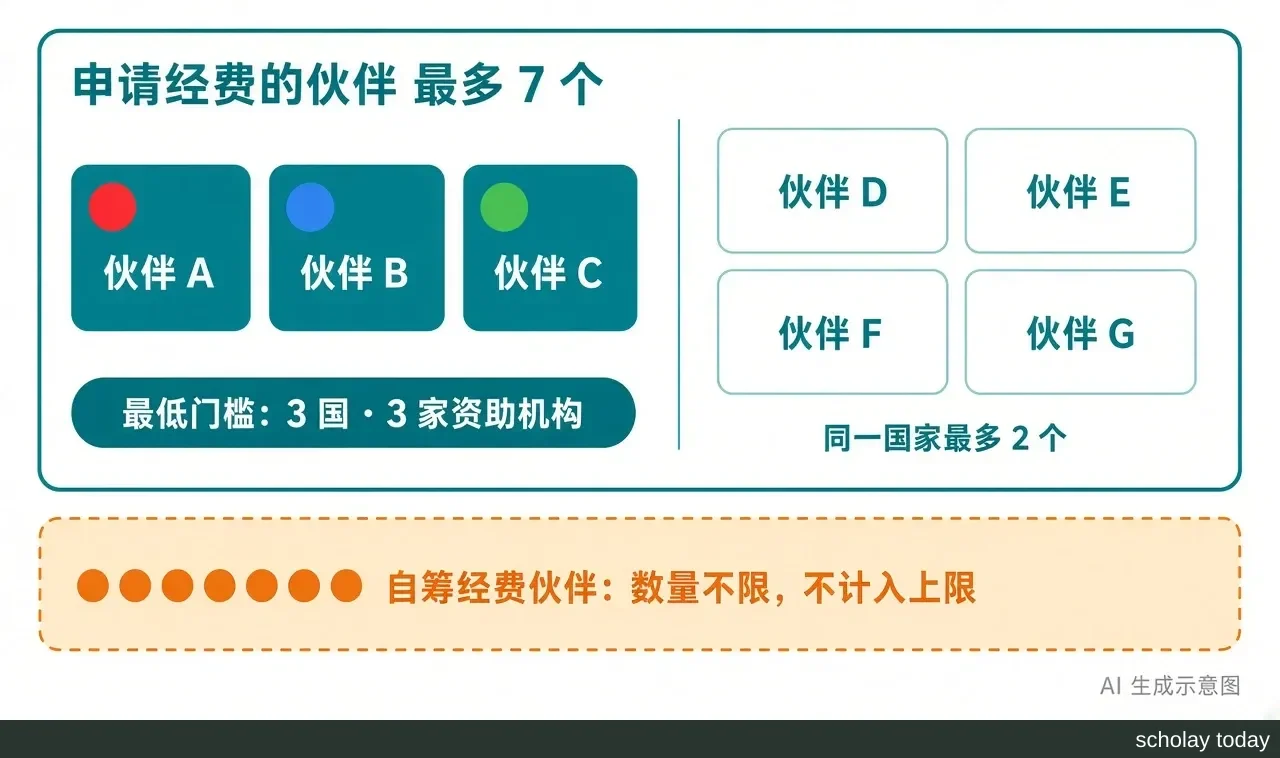
- The consortium shall include at least three partners from three different countries, each applying for funding to a different funding agency; all three partners must meet the eligibility criteria of the respective funding agency and must be independent of one another.
- The maximum number of eligible partners applying for funding is 7, with a maximum of 2 partners from the same country.
- The number of self-funded partners is unlimited and does not count toward the upper limit of seven.
- Public institutions, research organisations or higher education institutions from EU member states and associated countries shall have in place a Gender Equality Plan (GEP) compliant with the 'Horizon Europe' requirements as beneficiaries or affiliated entities at the time of signing the agreement and throughout the entire funding period.
- Both pre-application and full-text applications must be written in English.
Funding is allocated separately by national funding agencies to their respective partners and there is no central account for unified disbursement. For example, ANR only funds French partners of selected projects, with each partner receiving a maximum of 250,000 euros, and up to 350,000 euros for the lead project investigator. The funding amounts and additional requirements for other agencies vary according to their respective pages; ANR also reminds that national or regional agencies may require additional materials, and it is each partner's responsibility to submit these materials to the corresponding agency on time.
The participant list is not limited to EU countries and also includes institutions from the UK, Norway, Turkey, Egypt, and Moldova, but does not include Chinese funding institutions. According to the ANR website's definition of 'self-funded partners,' partners from non-funding countries may bring their own funds to participate, but cannot receive funding from this call, and cannot be counted toward the minimum threshold of 'three countries, three funding institutions.' For domestic researchers, a more realistic pathway is to join joint research consortia established by teams from participating countries and to confirm in advance whether their institution can cover its own funding requirements.
Timeline and application channels
As of October 23, 2026, this call is still in the preliminary phase. The indicative timelines provided on the Partners Program webpage and the ANR page are: opening on October 26, 2026, and submission of pre-applications due by January 11, 2027. The preliminary page states that the above information is provisional and subject to change based on the official announcement; when the Polish National Science Centre (NCN) forwarded it on October 21, it also noted 'this is not an official announcement'.
The dates on the institutional pages are not consistent. The Austrian ERA portal states that access will open on November 26, 2026; the Swedish Research Council (VR) national page indicates a period from October 26 to January 18, 2027, based on application through the Prisma system, and notes that specific information will not be provided prior to opening. The reasons for the discrepancy in this article could not be confirmed. Applicants should base their preparation on the official call text and the relevant national funding agency's webpage, using the earliest deadline as the reference point.
The application will be divided into two stages. In the first stage, the consortium will jointly submit a pre-application; only teams that receive an explicit invitation from the Joint Call Secretariat may proceed to the second stage to submit a full application. Proposals must be submitted through the EPSS system; proposals submitted directly to ANR will not be accepted; if any partner within the consortium applies for funding from the ANR, a synchronized registration must also be completed on the ANR's IRIS platform in the second stage. An online information session will be held on November 17, 2026, from 14:00 to 16:00 CET (i.e., 21:00 to 23:00 China Standard Time). The contact email for the Joint Call Secretariat is rch@anr.fr, and the Spanish State Research Agency (AEI) also has a contact email: jpich@aei.gob.es.
References
-
The following pages were verified on October 23, 2026; dates are not added to pages without a published date.
-
Heritage Research Hub. Pre-announcement of the first Joint Transnational Call of the RCH Partnership.
-
Agence nationale de la recherche. Foundations for climate-resilient cultural heritage: Assessing and managing impact and risk, dealing with damage and loss (RCH).
-
Swedish Research Council. Project grant for international research collaboration within Resilient Cultural Heritage (RCH).
-
Narodowe Centrum Nauki. Pre-announcement of the European Partnership Resilient Cultural Heritage 1st Call. 2026-10-21.
-
ERA Portal Austria. European Partnership for Resilient Cultural Heritage launches first call. 2026-10-20.
-
Heritage Research Hub. European Partnership for Resilient Cultural Heritage.
-
Information provided by Scholay Academic One-Stop Platform Organize and publish; if there is any infringement, please provide feedback for removal.
-
Information synchronization published in EnterScholar, Scholar Community in the Age of Intelligence