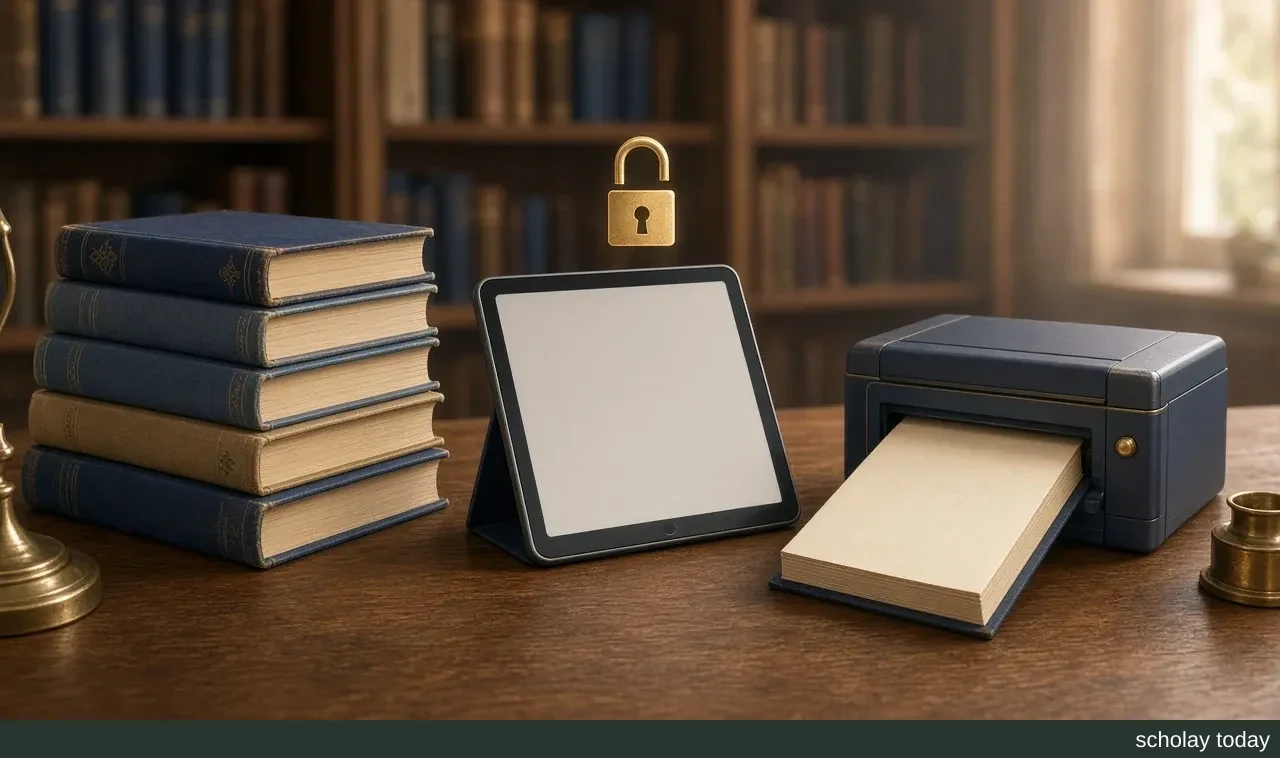
The theme of Open Access Week 2026 is “the cost of knowledge.” On October 21, academic book editor Jen McCall published a post on the LSE Impact Blog reviewing how the costs of academic monographs have changed from print to e-books to open access: a title often sells only one or two hundred copies, so publishers put out more titles and raise unit prices. This article checks the two studies she cites and adds material on library e-book licensing and open access monographs.
Cost Estimates and Sales Data
McCall has more than 30 years of experience in academic publishing. She has worked at Cambridge University Press, Wiley and Palgrave Macmillan, and now commissions books for Amsterdam University Press (AUP) and Central European University Press (CEU Press). In this post she writes in the voice of LSE Press, using “we” to introduce this digital-first university press that publishes only open access books. The piece is therefore both an industry overview and a press's account of itself: the cost and sales figures come from external research, while the benefits of print-on-demand and open access are mostly the publisher's own judgments.
The article's statement that “a book can cost as much as $130,000” comes from the Ithaka S+R report The Costs of Publishing Monographs, released in February 2016. The research team examined 382 monographs published in fiscal year 2014 by 20 American university presses, estimating staff time, direct expenses and press-level overhead across stages such as acquisitions, editing, design, production and marketing. Per-title costs ranged from $15,140 to $129,909; the average across the whole sample was $28,747 (direct costs only) or $39,892 (including overhead). The $130,000 figure is the highest value in the sample, not a typical cost. The study also counts only the cost of producing the “first digital file,” excluding the printing, binding and distribution of print copies, as well as author advances and royalties.
The sales and pricing data come from a survey report released in October 2021 by the Oxford International Centre for Publishing at Oxford Brookes University. In February–March 2021 the centre sent a questionnaire to English-language academic publishers and received responses from 25 commercial and university presses, which together published about 32,600 humanities and social sciences monographs in 2020, roughly three-quarters of all English-language monographs. Larger commercial publishers said a monograph sold on average fewer than 200 copies in its first three years, and larger university presses 200 to 400; by comparison, sociologist John Thompson's 2005 analysis showed that total monograph sales were often only 400 to 500 copies. Average hardback prices were £87.43 or $120.50 at commercial publishers and £74.80 or $88.14 at university presses. McCall's figures of “£50—100 at university presses and £70—120 at commercial publishers” are exactly the response ranges listed in this report.
On output, the report shows that 8 of 9 commercial publishers were publishing more titles than in 2015, with the largest all choosing “significantly more”; 11 of 15 university presses had increased output, with growth coming mainly from small university presses with annual turnover below £1 million, while larger university presses held steady or declined. McCall's summary that “all commercial publishers are publishing more” puts it slightly more strongly than the raw data. Her explanation is that at the start of this century publishers reported average sales per title in the thousands, but now only one or two hundred, so publishers sustain revenue through more titles and higher unit prices. She also cites Thompson's 2005 warning that too many titles can bury important books and add to the pressure on scholars to publish. Note that the report's data are all self-reported by publishers, and the report states that its pricing section offers only qualitative observations.
Licensing and Prices of Library E-books
The main buyers of monographs are libraries. The Oxford survey estimates that roughly half to three-quarters of print monograph sales go to institutional libraries. Electronic editions are nearly universal: 21 of the 25 publishers issue all new books in electronic form, distributed mainly through aggregator platforms such as EBSCO and ProQuest and through publishers' own book packages. As for single-copy e-book pricing, 42% of respondents said it matches print: most university presses use the paperback price as the benchmark, while among commercial publishers 3 price e-books the same as print, 2 price them lower, 3 at 80% of print and 1 at 90%. By the publishers' account, an e-book costs no more than a print book.
Librarians see a different set of numbers. In 2020, a group of UK academic librarians, researchers and students launched the #ebookSOS campaign, writing to the chair of the UK Parliament's Education Select Committee to request an investigation into academic publishers' e-book pricing and licensing. The open letter stated that under UK copyright law, university libraries cannot buy e-books the way individuals do and must purchase licensed versions for institutions. These versions are “almost always more expensive,” and single-user licenses often cost ten times as much as the same print book. That year, the letter said, two well-known publishers raised single-user e-book prices by more than 200% without notice, and publishers also withdraw licenses that have already been purchased or switch them to annual renewals. A guide the campaign released in 2021 gave two examples: a book whose Kindle edition sold for £33.49 cost £650 for a 3-user institutional license, and a book priced at £51.99 in print cost £1,050 for a 3-user license. These examples were crowdsourced by librarians and reflect an advocacy position; the Education Select Committee ultimately did not open an inquiry.
The price gap stems mainly from how licenses are priced. A 2020 explainer from the York St John University library listed the common options. DRM-free licenses that allow unlimited simultaneous readers and full downloads are usually the most expensive, at many times the print price. Usage-based licenses buy 200 to 400 logins per year in a single purchase. Licenses that limit concurrent users (commonly 1 or 3) charge roughly the print price multiplied by the number of users. In other words, institutional licenses are priced by “how many people can read at once, and for how long,” not by the physical copy. A print book belongs to the library once bought and cannot be taken back by the publisher; copyright law also does not allow institutions to scan entire print books for remote reading, so libraries that need an electronic version have almost no alternative. The two sets of figures do not necessarily contradict each other: the publisher survey asked about list prices for single-copy e-books, whereas the librarians' examples mostly concern multi-user institutional licenses. But the open letter also says single-user licenses often reach ten times the print price, which does not match the publishers' self-reported pricing, and the available material cannot determine which side is more representative.
These costs ultimately fall on readers and authors. The open letter said that during the pandemic libraries could only acquire e-books, and many teachers had to build course reading lists around “which books have e-versions and are affordable.” The #ebookSOS guide advises authors to ask publishers before signing whether libraries can buy the e-book separately, whether the license is single-user or multi-user, and whether it is a one-off purchase or an annual subscription. If the terms are unsatisfactory, authors can switch publishers or choose open access. McCall's post does not discuss library e-book prices; this section draws on materials from the library side.
Print-on-Demand and Print
Print did not disappear once e-books became widespread. In the Oxford survey, all publishers but one planned to issue print editions of all new books; most commercial and university presses said more than 75% of print sales came from print-on-demand or ultra-short-run digital printing. With print-on-demand, publishers do not have to estimate first print runs or hold stock, so books need never go out of print, which matters especially for humanities and social sciences books with very long sales cycles. McCall says LSE Press can print books one order at a time, without large print runs or warehousing, and so reduces its carbon footprint. She gives no emissions data; this is the publisher's description of its own practice.
The survey also recorded reservations. One commercial publisher felt that print-on-demand quality still falls short of traditional printing, that it is unsuitable for image-dependent disciplines, and that authors generally dislike it. One university press said that print revenue was declining and that, although e-book revenue was growing, it was far from enough to make up the difference.
Payment Models and Controversies in Open Access Monographs
McCall argues that publicly funded research should be freely available, for books as well as for journal articles. She writes, however, that open access mandates for books in the UK and Europe, along with the supporting infrastructure, remain “up in the air.” For UK Research and Innovation (UKRI), the rules are already in force: monographs, book chapters and edited collections published on or after January 1, 2024 that must acknowledge UKRI funding have to be made freely available within 12 months of publication via a publishing platform, publisher website or institutional repository, under a Creative Commons license (CC BY preferred). Exemptions apply in cases such as contracts signed before 2024, the only suitable publisher being unable to offer a compliant option, support solely from training grants, or third-party material for which permission cannot be obtained.
The most direct payment method is the book processing charge (BPC), paid by the author or their funder. Springer Nature, for example, lists on its website open access monograph BPCs starting at €12,905, $14,875 or £10,938, excluding VAT. McCall points out that BPCs are far higher than journal article processing charges and that it is a serious problem where the money will come from. The greatest pressure falls on scholars at underfunded institutions, scholars in low- and middle-income countries, and humanities and social sciences scholars.
The past decade has seen approaches that do not charge authors. One type is the library-based open access press; McCall cites LSE Press, UCL Press and University of Huddersfield Press, where libraries redirect part of their budgets to support open publishing. Another type is collective library funding. Under CEU Press's Opening the Future program, libraries pay an annual membership fee in exchange for DRM-free, unlimited-user access to a collection of backlist books, which they keep permanently after three years. The fees are used only to publish new books open access, so authors do not need to raise BPCs, and a new book is published each time enough money has accumulated to cover one. McCall herself commissions for CEU Press, but this post does not mention the program.
Knowledge Unlatched (KU) is the best-known and also the most controversial example of the collective library funding model. Founded by Frances Pinter in 2012, it had libraries in many countries jointly fund the conversion of scholarly books and journals to open access. In 2018, Marcel Knöchelmann, a former KU employee, published a critique on the LSE Impact Blog. He wrote that KU had changed from a UK community interest company into a German limited company wholly owned by the consultancy fullstopp, a change that was barely explained in public. He also argued that there was a conflict of interest, because fullstopp had at the same time been hired to collect and analyze data for UK open access policy. After Wiley acquired KU in 2021, the open book project COPIM issued a statement arguing that the acquisition of open access infrastructure by large commercial companies threatens the principle that such infrastructure should be owned and governed by the research community. On June 26, 2025, the nonprofit publisher Annual Reviews announced an agreement with Wiley to take over KU, describing it as a “return to nonprofit,” with the team and programs unchanged.
OAPEN takes a different path: it does not fund publication but provides nonprofit hosting and dissemination infrastructure. OAPEN operates the OAPEN Library of open books and, in partnership with OpenEdition, runs DOAB, the Directory of Open Access Books. According to the fee schedule on its website, publishers pay a one-off €10 for each new current-year title uploaded and €2 per title per year for backlist titles, with a minimum annual fee of €175. Fees are waived if the publisher's affiliated library or institution is funding OAPEN, or if the title is already covered by a funder agreement. DOAB is free for publishers but requires external peer review, open licenses and at least 3 open access books. In the Oxford survey, some publishers also mentioned distributing open access monographs through OAPEN.
McCall's conclusion leans optimistic: print-on-demand reduces the environmental cost of print books, open access makes the cost to readers “disappear entirely,” and models that do not charge authors are emerging. She therefore asks whether academic book publishing is moving toward greater inclusivity and equality. The price for readers can indeed fall to zero, but publishing costs remain; they are simply shifted to authors, funders or libraries. Whether BPCs are affordable and who governs collective funding platforms are exactly the questions still being debated around open access monographs.
References
-
McCall, J. (2026, October 21). From print to digital and back again – Why the cost of academic books keeps changing. LSE Impact Blog.
-
Amsterdam University Press. Jen McCall.
-
Maron, N. L., Mulhern, C., Rossman, D., & Schmelzinger, K. (2016, February 5). The Costs of Publishing Monographs: Toward a Transparent Methodology. Ithaka S+R.
-
Shaw, P., Phillips, A., & Bajo Gutiérrez, M. (2021, October). Arts, Humanities and Social Sciences Monographs: A Report on Publishing Trends. Oxford International Centre for Publishing, Oxford Brookes University.
-
Shaw, P., Phillips, A., & Bajo Gutiérrez, M. (2022). The Death of the Monograph?. Publishing Research Quarterly, 38(2), 382–395.
-
#ebookSOS. (2020). Original Open Letter. Campaign to investigate the academic ebook market.
-
#ebookSOS. (2021, May 20). Can my students read my books? Guidance for academics on negotiating contracts with publishers.
-
York St John University. (2020, May 12). Lobbying for fairer ebook access. Information in the Curriculum.
-
UK Research and Innovation. UK Research and Innovation open access policy.
-
UK Research and Innovation. Making your monograph, book chapter or edited collection open access.
-
Springer Nature. Open access books pricing.
-
CEU Press. Opening the Future: About.
-
Knöchelmann, M. (2018, October 3). Knowledge Unlatched, failed transparency, and the commercialisation of open access book publishing. LSE Impact Blog.
-
COPIM. (2021, December 15). Copim statement on the corporate acquisition of OA infrastructure.
-
Annual Reviews. (2025, June 26). Knowledge Unlatched Finds a New Home with Annual Reviews.
-
OAPEN. Join the OAPEN Library.
-
Compiled and published by Scholay, the one-stop academic platform. If this content infringes your rights, please let us know and it will be taken down.
-
Also published on EnterScholar, a community for scholars in the age of AI.